
Cloud Computing Services
Leverage the power of Cloud Computing for your business. Boost productivity, streamline communication and take the office everywhere with you.
Cloud computing is simply accessing a computing resource that is based somewhere other than where you are, via the internet.
Most of the world’s most popular websites use cloud computing. Facebook, Gmail and Twitter, for example, are all effectively applications you are interacting with without ever installing anything.
All the actual ‘work’ or processing, is done at the other end, not on your device (PC, laptop, tablet or even a smartphone). As long as it’s connected to the internet, you can interact with these cloud services with a few clicks.
Cloud computer services offer far more flexibility and with the rapid rate at which technology is evolving, investing in bulky equipment may not be the best idea.
Additionally, these advancements in technology also mean that Cloud Computing is very cost-effective due to its ‘pay for what you use’ capabilities. As well as this, payments are taken monthly, meaning less CAPEX costs and easier budgeting for your finance department.
In summary, the benefits that Cloud Computing offers make the idea of owning and running an IT infrastructure in-house no longer necessary– particularly in the SME sector.
Yes – the three main types of Cloud computing are:
- Private Cloud
- Public Cloud
- Hybrid Cloud
Without utilising the power of Cloud Computing, your business could run the risk of:
- An unproductive team due to outdated and slow systems
- Not standing out to competitors – prospects will want to trust that your business is capable and progressive
- Data loss due absence of cloud-to-cloud backups
- Zero flexibility when it comes to remote-working or working on the go
Is IT Support driving your business forward?
Business Computer Solutions (BCS) is a Kent–based provider of Managed IT Support, Cybersecurity and AI Solutions, with our office in Ramsgate, Kent.
We want to offer IT Support solutions that work for your business – whether it’s increasing efficiency, competitive advantage, or increasing staff productivity we’re here to help your business grow through technology.
Different Types of Cloud Computing
Private Cloud
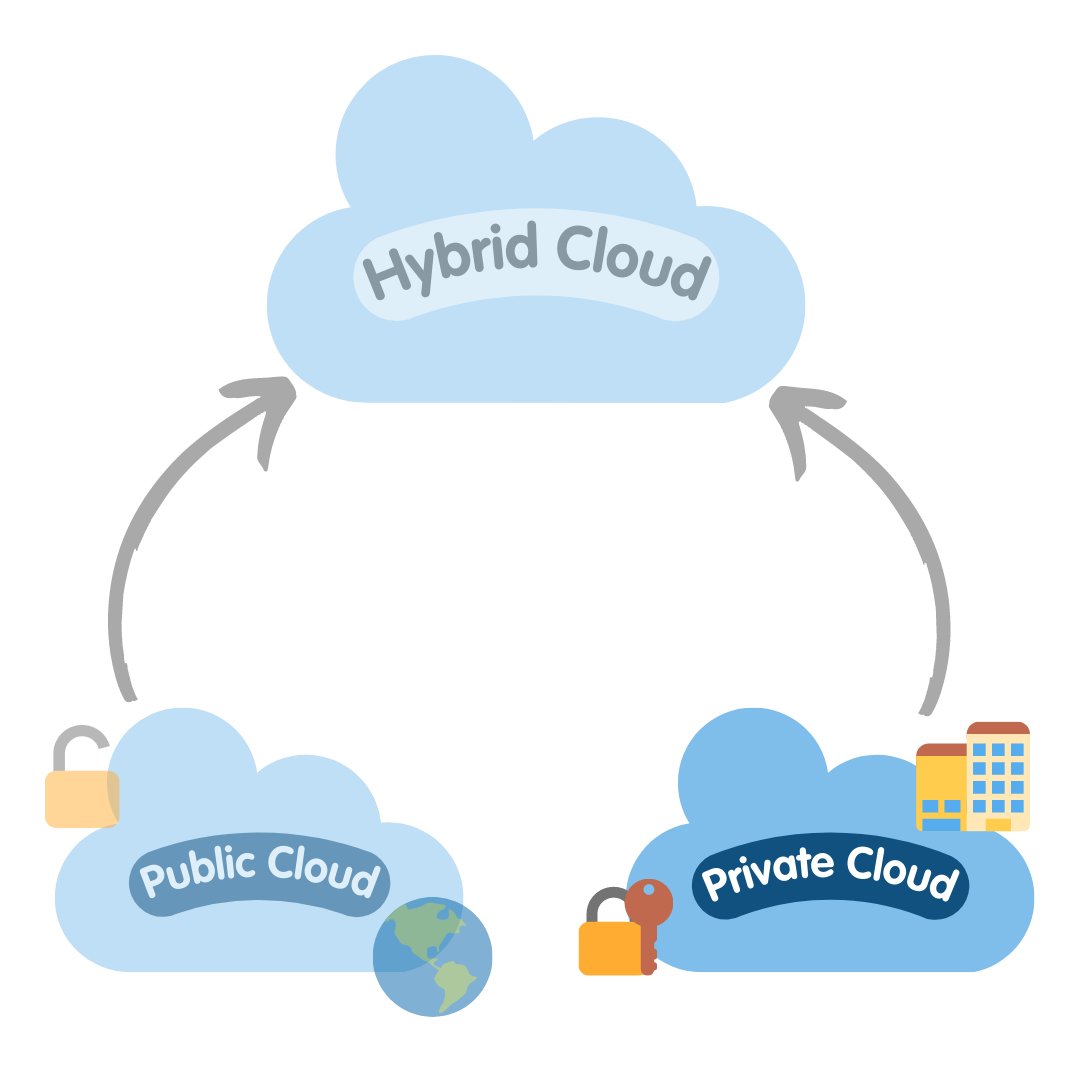
A private cloud is very simply the same as a public cloud. However, all of the physical servers are owned by the same company. Where they reside is not important. It may be a purpose-built data centre or even a data centre in their own building. Often, companies will decide to own their own servers and then house them in a purpose-built data centre. This is called co-location.
Advantages of a private cloud are:
- Dedicated or owned hardware
- Control of the service
- Perceived increase in security
- Easy to scale
Disadvantages of a private cloud are:
- High cost of ownership
- Ongoing cost
- Potential underutilized hardware if not used
- In-house skills required to operate and maintain
Public Cloud
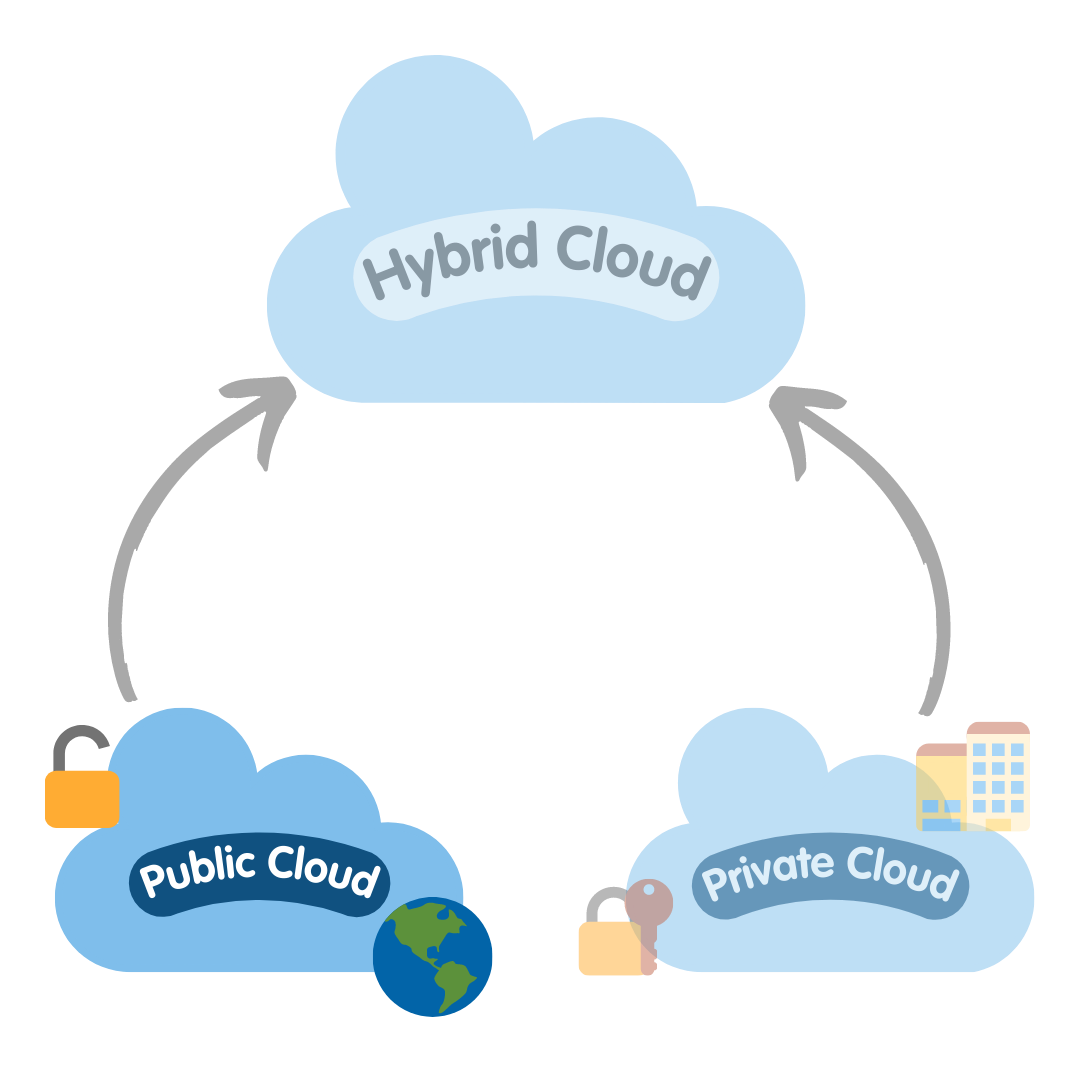
A public cloud is a service operated by a company such as Amazon or Rackspace. They offer computing resources on a pay-as-you-use basis as we discussed earlier.
The advantages of a public cloud are:
- Pay as you go
- Elastic (increase and decrease resources i.e. speed, storage with a direct effect on cost)
- No ownership of hardware
- The service is 100% outsourced
- Low entry-level costs
The disadvantages of a public cloud are:
- Shared hardware (in most cases but not all)
- Blackouts (if the service is unavailable)
- Potential privacy and data laws may prevent use of certain public clouds in certain geographical areas
- Perceived as less secure
- Can be costly over long periods of time
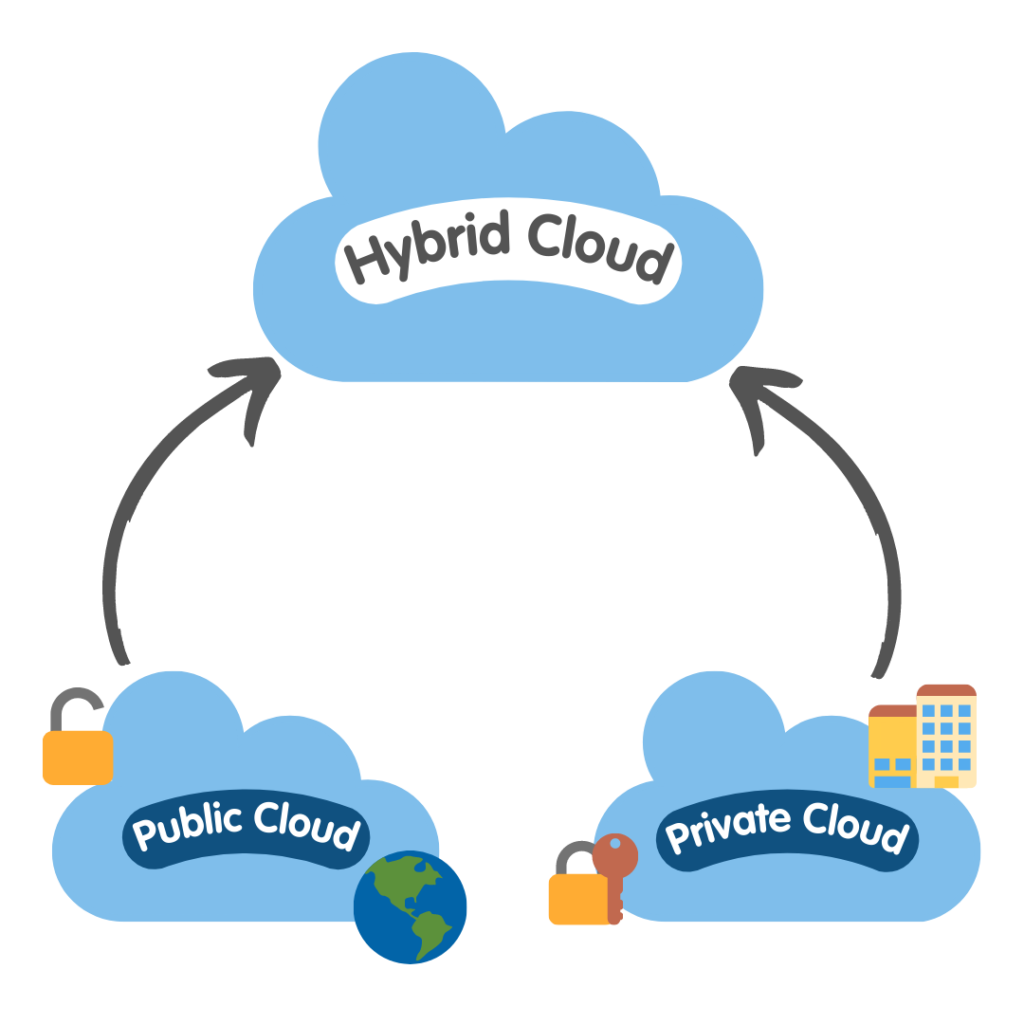
Hybrid Cloud
A hybrid cloud is exactly as it sounds a hybrid of both a private and public cloud. These are often used when a company’s own private cloud is nearing capacity and requires additional resources.
A hybrid cloud provides the ability to burst into a public cloud, so any services running are not affected. Another example is when critical workloads are run on the private cloud and less critical loads are run in the public cloud.
Advantages of a Hybrid Cloud:
- Low cost of entry for existing private cloud owners to expand to hybrid.
- Scalable (quick and easy to expand into a public cloud)
- Security (keep critical and sensitive data in private)
- Pay as you expand only
Disadvantages of a Hybrid Cloud:
- Complex service level agreements
- Difficult vendor alignment (compatibility with both clouds)
- Elements that run in public cloud are considered less safe
- Private Cloud
-
Private Cloud
A private cloud is very simply the same as a public cloud. However, all of the physical servers are owned by the same company. Where they reside is not important. It may be a purpose-built data centre or even a data centre in their own building. Often, companies will decide to own their own servers and then house them in a purpose-built data centre. This is called co-location.
Advantages of a private cloud are:
- Dedicated or owned hardware
- Control of the service
- Perceived increase in security
- Easy to scale
Disadvantages of a private cloud are:
- High cost of ownership
- Ongoing cost
- Potential underutilized hardware if not used
- In-house skills required to operate and maintain
- Public Cloud
-
Public Cloud
A public cloud is a service operated by a company such as Amazon or Rackspace. They offer computing resources on a pay-as-you-use basis as we discussed earlier.
The advantages of a public cloud are:
- Pay as you go
- Elastic (increase and decrease resources i.e. speed, storage with a direct effect on cost)
- No ownership of hardware
- The service is 100% outsourced
- Low entry-level costs
The disadvantages of a public cloud are:
- Shared hardware (in most cases but not all)
- Blackouts (if the service is unavailable)
- Potential privacy and data laws may prevent use of certain public clouds in certain geographical areas
- Perceived as less secure
- Can be costly over long periods of time
- Hybrid Cloud
-
Hybrid Cloud
A hybrid cloud is exactly as it sounds a hybrid of both a private and public cloud. These are often used when a company’s own private cloud is nearing capacity and requires additional resources.
A hybrid cloud provides the ability to burst into a public cloud, so any services running are not affected. Another example is when critical workloads are run on the private cloud and less critical loads are run in the public cloud.
Advantages of a Hybrid Cloud:
- Low cost of entry for existing private cloud owners to expand to hybrid.
- Scalable (quick and easy to expand into a public cloud)
- Security (keep critical and sensitive data in private)
- Pay as you expand only
Disadvantages of a Hybrid Cloud:
- Complex service level agreements
- Difficult vendor alignment (compatibility with both clouds)
- Elements that run in public cloud are considered less safe
Benefits of Cloud Computing for Businesses

Competitive Advantage
A Cloud Computing service can reduce the overall costs of managing and maintaining your IT systems.

No surprises
Cloud Computing also means regular and predictable costs, making surprise bills and charges a thing of the past.

On the Go
With a virtual office in the Cloud, you can take your work with you, connecting wherever and whenever you want.

Secure
We deliver Cloud computer solutions that are safe, secure and offer up-times exceeding 99%.

Scalable
Your Cloud Computer service can grow and shrink, depending on the needs of your business. It’s totally flexible and future-proofed.

Streamlined
Super efficiency is another of the Cloud’s superpowers, as you’ll only use and pay for the applications you need.

Compliant
Every Cloud support service we provide will deliver instant compliance that’s easy to track and always up to date.
Automatic Updates
When the latest app updates fly in, they’ll be installed across your network in a flash, all in one place.
Saas vs PaaS vs Iaas - Which Should I Choose?

Software as a Service (SaaS)
This is by far the most recognisable of the services and is often an end product of both IaaS and PaaS. Software as a service is any application that is delivered over the internet, such as Hotmail (Outlook.com) from Microsoft or Salesforce – the online CRM platform. SaaS is generally the end product a consumer will interact with. The opportunities in this space are endless and every day more and more services are being released.
As a result, this way of delivering applications has revolutionised the software industry. There are tens of thousands of SaaS applications available today stretching across every business sector you can imagine. Installing applications onto local PCs via CD Rom or DVD is a thing of the past.
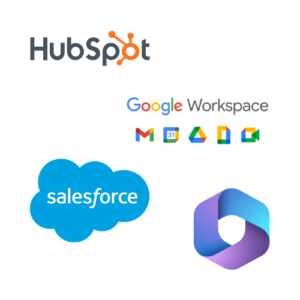
examples: Hubspot, Google Workspace, Salesforce & Microsoft 365
.
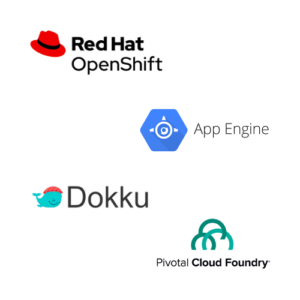
examples: RedHat Openshift, Google App Engine, Dokku (Opensource), Pivotal Cloud Foundry
Platform as a Service (PaaS)
PaaS also provides the underlying hardware i.e. servers, storage and networking but this time the service also provides a software layer to enable the consumer to build an application. There are various different options that the consumer can choose from before deployment.
The main reason why PaaS is a popular offering is for application developers to quickly deploy servers and then upload their applications for testing purposes. They often run a series of tests then take the server down. They would then make changes and repeat the process.
.
Infrastructure as a Service (IaaS)
IaaS is simply where a company outsources their requirement to have hardware such as servers, storage, and associated networking to a third party who runs and maintains this service for a monthly fee. This is hosted in the third parties’ data centre and it is the responsibility of the third party provider to keep the lights on (keep the system up and running).
This is a popular choice with companies that want to control the whole environment and typically run services such as email or a line of business application.
examples: Microsoft Azure, Oracle Cloud Platform, Amazon Web Services, Google Cloud



Your Cloud journey starts here
Looking for some help with the cloud? Or for someone to take the headache out of managing your technology, period?